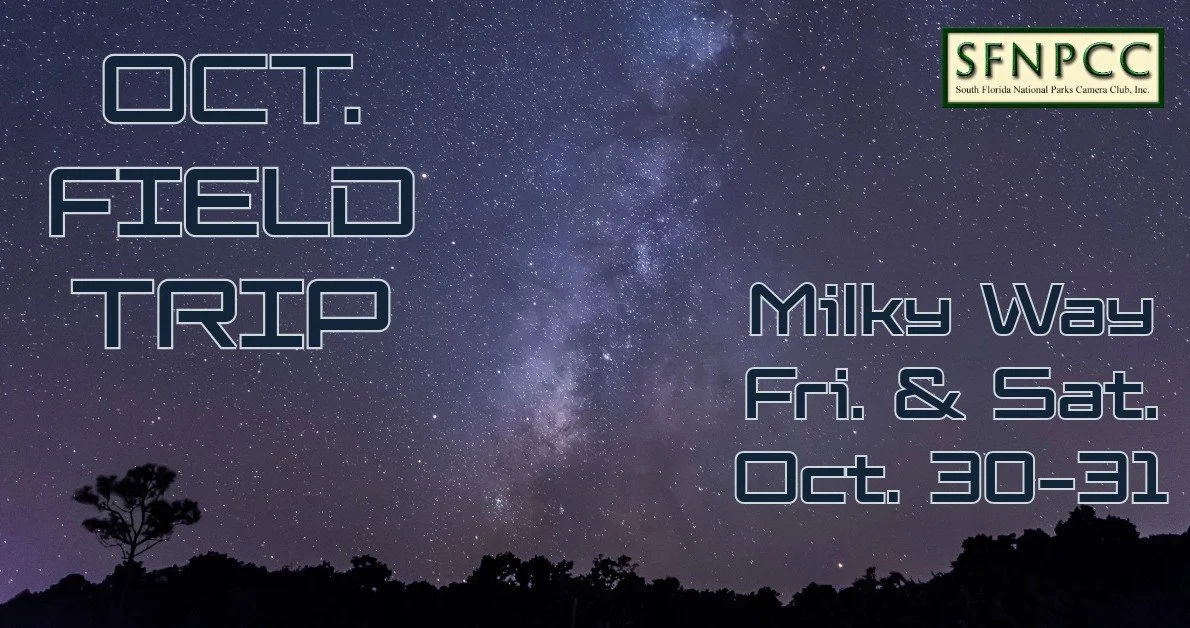
October Field Trip - Milky Way
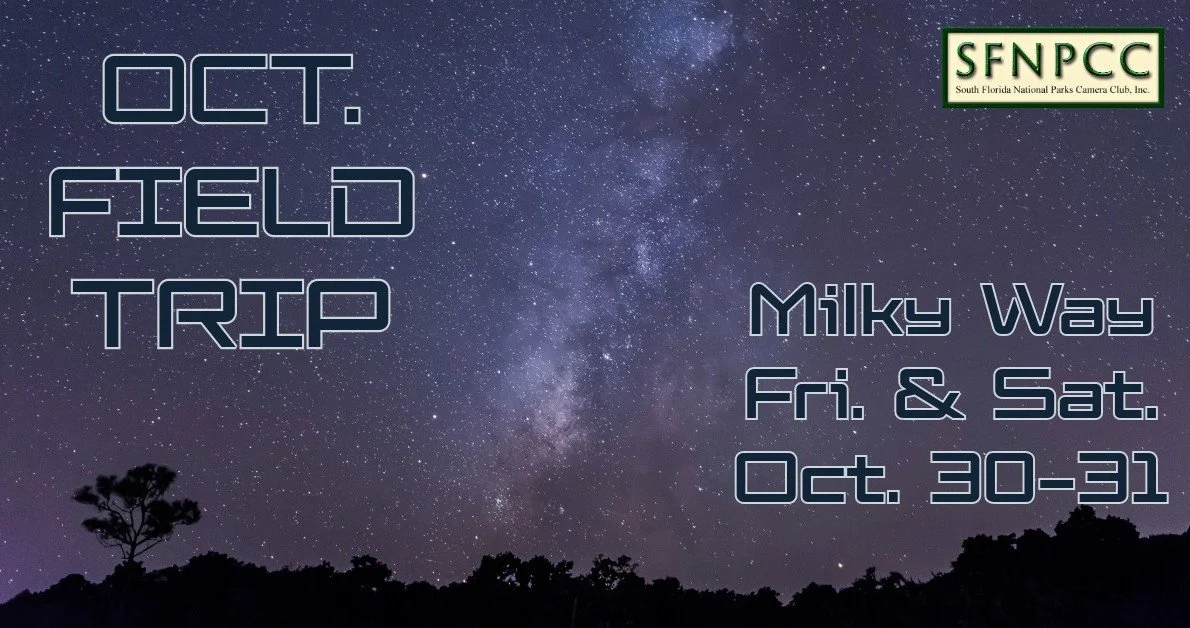
Let’s try this once more! At the time I’m scheduling this event (early September) I’m setting aside both nights in case we have bad weather - AGAIN! (Let’s hope not🤞.)
On Friday Oct. 30th and Saturday Oct 31st, the moon doesn’t rise until later in the evening (11pm and 12:07am respectively), giving us a full evening to photograph the milky way.
This time of year, the milky way will be visible as soon as night falls, beginning at 7:30pm, and by 8pm will be in full view. It will be rising in the southwest sky. Because of that, I thought we might park along the Main Park Road near the southern end of the park.
THINGS TO KNOW BEFORE YOU GO
Homework: (Review attached PDF - email info@sfnpcc.org with any questions)
a) learn where, and know how, to adjust shutter speed, aperture, and ISO, as well as program your in-camera timer, in the dark;
b) learn how to get focus in the dark;
c) learn how to program your in-camera timer (or use wired shutter release).
Don’t worry if you don’t know what to do or what settings to choose. As long as you know how to adjust your camera, I will work with you to show you how to capture the milky way.
WHAT TO BRING
a) camera
b) your widest lens with the largest aperture (smallest f-stop number)
c) sturdy tripod
d) wired shutter release or intervalometer
e) lawn chair or portable stool
f) refreshments
g) full tank of gas
h) your full mosquito arsenal
Most of all, patience!
As always, shooting a milky way is totally weather dependent. We are at the mercy of cloud cover. If we have thick overcast cloud cover, we can’t see any stars and therefore no milky way. Sunset may be colorful, or it may be snuffed out. One never knows.
CANCELLATION: The only way we will cancel is if all of my weather forecast apps are in agreement for cloud cover or thunderstorms. And goes without saying, if tropical weather watches or warnings are in effect, we will cancel. But, we will hope for the best!
Please RSVP if you’re planning on attending. Hope to see you all then!