
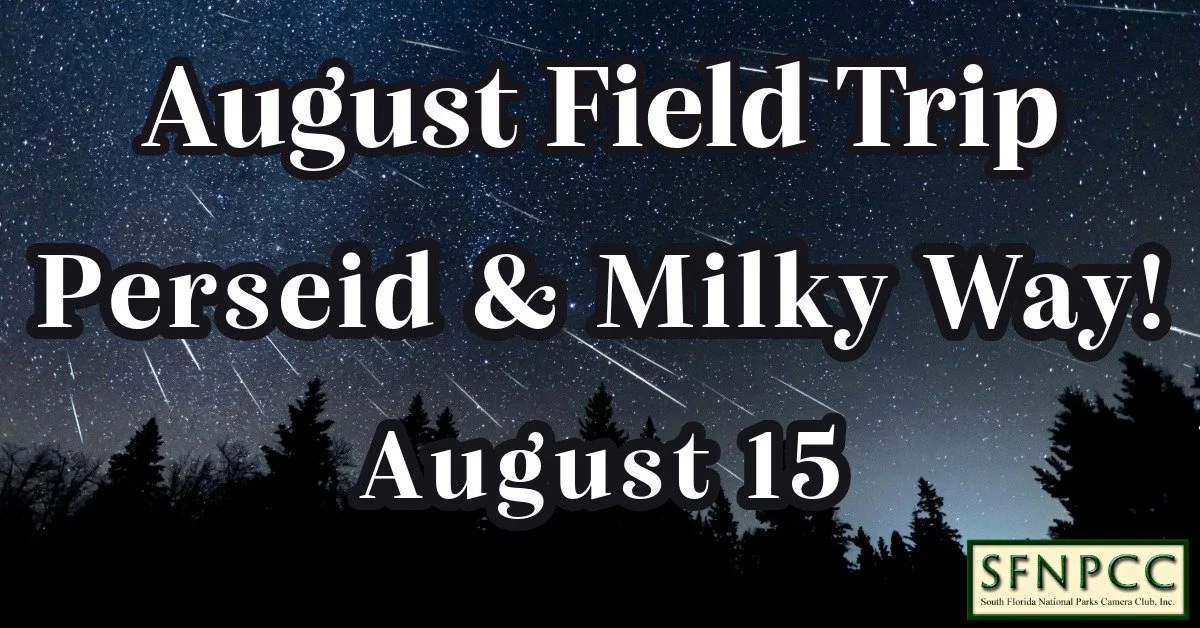
The peak of the Perseids meteor shower is just before dawn on the mornings of Aug. 12th and 13th, which doesn’t fall on a weekend. If you really want to photograph meteors, I recommend going out in the early morning of the 12th and 13th (a few hours before dawn) to capture them fully. Unfortunately, I have to work so you’ll have to do this on your own.
However, we can try our luck on Saturday the 15th! The moon will be up until around 9:30pm, but it’ll just be a sliver. No real effect on our photos. We can take advantage of a dark sky for milky way and any errant meteors that come across our field of view.
Meet at Ernest Coe - Caravan rolls out at 6:30pm sharp so be early.
Arrive at Location at 7pm - set up and shoot for the sunset (8pm)
Nautical Twilight ends around 8:48pm - we should be able to see stars shortly after. The moon sets around 9:30pm, but it’s a small sliver. Shouldn’t affect our photos.
Feel free to set up for any meteors by using a timelapse, or just shoot the Milky Way.
Stay until you’ve had enough.

Photographing a meteor or meteor shower is like photographing lightning. If you try to capture it after you see it, you’ll never capture it. Its just too fast. Photographing meteors requires planning, specific camera setup, and patience! You need to get set up ahead of time so your camera can capture the meteors as they happen, not after you see them fly by.
What to bring!
Gear: Camera, widest lens with fast aperture (low numbered F-stop), sturdy tripod, remote shutter release cable (or similar).
Extras: chair to relax in, refreshments: water, coffee, snacks, etc.
BUG SPRAY, THERMACELLS, BUG JACKETS, BRING YOUR ENTIRE BUG REPELLENT ARSENAL!
Be sure your car is fully gassed up as we’ll be going pretty deep into the Glades.
What to know! - DO YOUR RESEARCH AHEAD OF TIME!
Study up on how to focus to infinity in the dark. If you’re unsure, do a YouTube search for your specific camera make and model and “focus to infinity for night photography”. If you can’t find anything, just shoot me an email and let me know. I’ll see if I can find something for you. The time to ask these questions isn’t on the day of the event. Just sayin’! And FYI, you don’t need to be in the deep dark night to practice focusing; you can practice in your backyard.
How to set up your camera to shoot intervals. Best way to shoot meteors is to set up your camera to automatically shoot in intervals, like for a timelapse, and then pick our the frames afterward that have the meteors in them. And when you’re done, you’ll have a grouping of images to use for a timelapse video if you so desire. So learn how to program your camera to shoot in intervals, or use a wired shutter release to do the same.
Hope to see you there!